
What Are the Risks of Not Keeping Product Records?
Product records are more than stored files: they connect identity, batches, key fields, evidence, versions and access rights. This article examines the risks for customer audits, recalls, after-sales disputes, product claims and future data reconstruction.
It is used for information collation, scanning code display, evidence filing and risk warning; it does not claim official certification, nor does it replace formal compliance review.
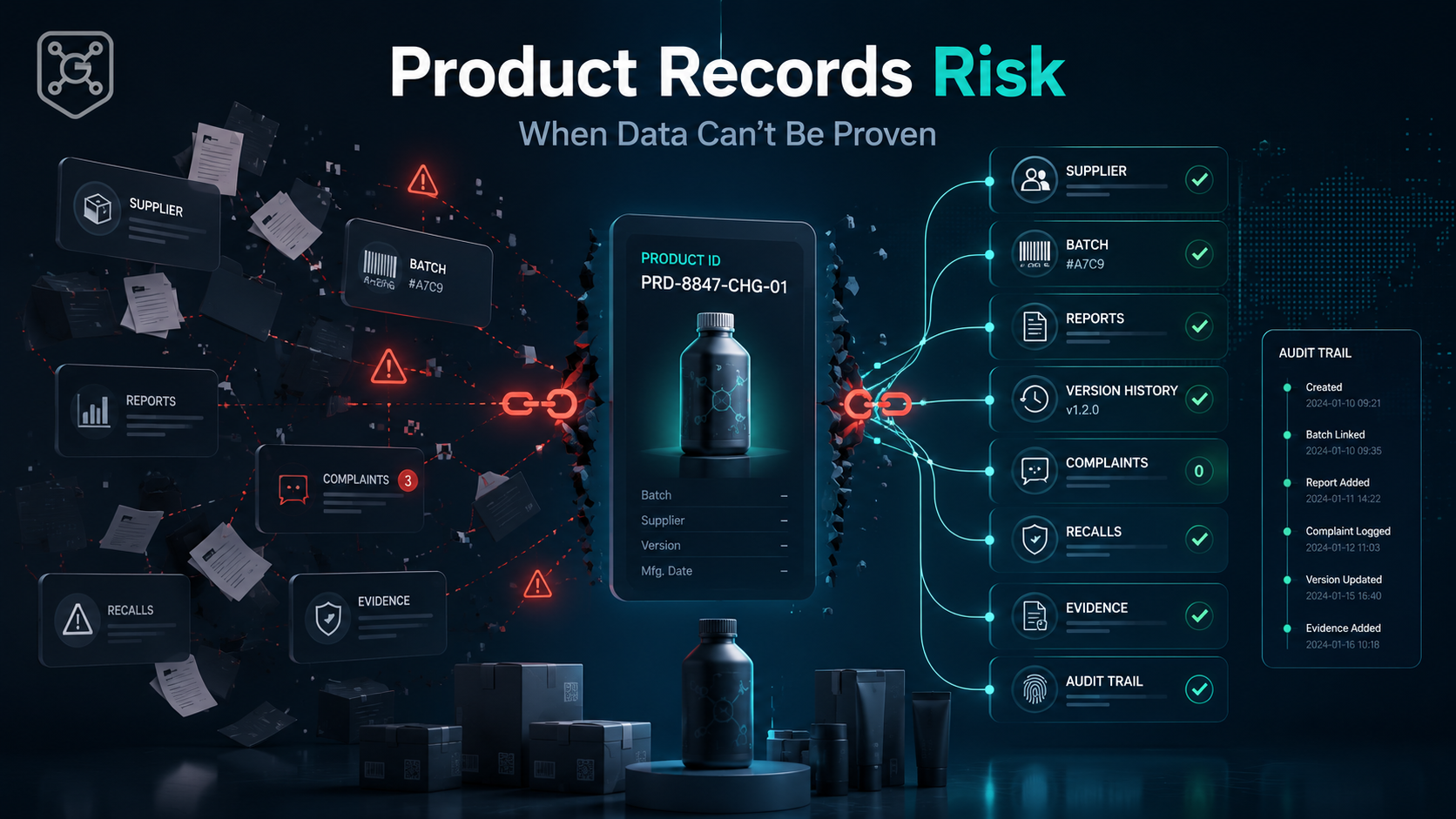
Product records are more than stored files: they connect identity, batches, key fields, evidence, versions and access rights. This article examines the risks for customer audits, recalls, after-sales disputes, product claims and future data reconstruction.
What are the risks of not keeping product records?
Many companies are not completely without information. The product parameters are in the ERP, the test report is in the quality department, the supplier statement is in the purchase mailbox, the packaging documents are in the design computer, and the after-sales records are in the customer service system.
The problem is that this information does not form a traceable record around specific products. There is no visible impact when business is normal. Once random inspections, complaints, recalls, customer reviews or supplier changes occur, companies will find that although there are many documents, it is difficult to prove which product, which batch and which time they belong to. point.
Therefore, the risk of "not keeping product records" is not just that a file is missing, but that the company loses the ability to quickly explain facts.
1. What is a real product record?
Product records are not completed by stuffing all information into one folder, nor is it completed by pasting a QR code on the product. It has to answer at least a few basic questions:
- What product is this and how can it be uniquely identified?
- Who produces, sells or takes responsibility for it?
- Where do key materials, parameters and statements come from?
- Which is the corresponding test report, instructions and authorization document?
- When did this information take effect and have it changed since then?
- What can consumers, partners and reviewers see respectively?
Only when identities, fields, evidence, versions, and access boundaries can correspond to each other can commodity records truly have useful value.
2. Risk 1: When customers and platforms require information, companies can only temporarily splice them together
Customer reviews usually don't just ask "Is there a certificate?" They are more concerned about whether the certificate covers the current model, whether the material declaration comes from a real supplier, and whether the packaging label is consistent with the test results.
Companies without product records can only temporarily piece together answers through sales, procurement, quality and research and development. The longer the information is searched, the more likely it is for customers to doubt the company's management capabilities; if the versions given by different departments are inconsistent, even if the product itself is not problematic, it will increase transaction resistance.
| Questions raised by customers | When there is no commodity record | When complete records are available |
|---|---|---|
| Which model does this report correspond to? | Judging by file names and employee memories | Directly view product, model and evidence associations |
| Has the material changed suppliers? | Re-review purchase emails and historical orders | View supplier and version change records |
| Are the parameters on the page valid now? | Unable to confirm which version of data is used on the page | Ability to check the current effective version |
| Can you provide machine-readable data? | Manual copying from PDF to form | Export structured data by field |
3. Risk 2: When quality problems occur, the scope of investigation is forced to expand
After a product has a problem, the company must first judge the scope of influence. Is there a risk for a single item abnormal, a batch, a supplier, or the entire model?
If the goods do not have stable identities and batch records, it is difficult for companies to quickly narrow down the scope. The problem of only one batch of goods originally needed to be processed may turn into a suspension of sales of all quantities, expanded recalls, or order-by-order inspections. What is really expensive is often not the problem itself, but the additional damage caused by the inability to accurately locate the problem.
The clearer the record, the more the company can control the disposal within a reasonable range; the more blurred the record, any small problems may be amplified.
4. Risk 3: After-sales disputes can only rely on verbal explanations from both parties
In e-commerce, jewelry, beauty, alcohol, electronic products and other scenarios, after-sales disputes often involve package switching, wrong delivery, batch differences, improper use and secondary circulation.
If the company can only provide order screenshots and product pages, it will be difficult to explain the identity of the actual delivered product, the information displayed at the time, and what subsequent verifications have occurred. Consumers say one thing and merchants explain another, which often turns into a costly pull.
The commodity record cannot automatically determine all disputes, but it can at least provide objective reference: whether the commodity identity is valid, what version of the information is, when it was queried, whether abnormal frequencies occurred, and whether evidence documents existed at the time.
5. Risk 4: Enterprises are prone to deviations between publicity and actual data
Marketing pages like to use expressions such as "environmentally friendly","sustainable","safe materials","recyclable" and "traceability of origin". Once these statements enter advertising, packaging or customer proposals, they need to have corresponding basis.
When there is no product record, marketing content and evidence materials are often maintained by different teams. Publicity has been updated, but tests or supplier statements have not been synchronized; or evidence only covers a certain batch but is written as a long-term commitment for the entire series.
Such risks do not necessarily come from deliberate exaggeration, but more often, the version is out of control. Connecting each key statement to source evidence, scope of application, and duration of validity can significantly reduce this deviation.
6. Risk 5: The cost of supplementing data in the future is usually higher than that of creating records now
Many companies believe that there is still time to do so when customers actually request DPP or structured data. The problem is that the longer the historical data is, the more difficult it is to supplement it.
| What is not recorded now | Problems that may be encountered when making up recordings in the future |
|---|---|
| Supplier and Material Version | The supplier has been changed, and the original contact person and documents cannot be found |
| Relationship between batch and test report | You can only guess based on the date and cannot form a reliable correspondence |
| Packaging and Instructions for Use Version | Old files are overwritten and the content displayed at that time cannot be restored |
| Product verification and abnormal recording | Past behaviors cannot be replicated, and the risk trajectory is permanently missing |
| Evidence validity period and reasons for change | We only know that the file exists, but we don't know when it will expire or why it will be replaced |
Commodity records have obvious time value. Start recording today and continue to accumulate in the future; wait until it must be submitted and then trace back history, and often only get incomplete answers.
7. Commodity records are not "the more the better"
The purpose of recording is to make necessary information verifiable, verifiable and transferable, rather than collecting data indefinitely. Companies should pay special attention to three boundaries:
- Consumer personal information is not collected indiscriminately for product compliance purposes.
- Sensitive data such as trade secrets, formulas, and complete supplier lists should not be disclosed by default.
- Different roles access only the information they need to complete their tasks and maintain access logs.
Good product records emphasize both transparency and authority. Consumers can see public information, partners can obtain the fields needed for performance, reviewers can view more complete evidence after authorization, and the company retains the version and audit information internally.
8. Enterprises can first establish a set of "minimum commodity records"
| recording layer | Recommended content to do first | solve the problem |
|---|---|---|
| identity layer | PID, SKU, model number, batch number, or GTIN | Clearly record which product belongs to |
| base data layer | Name, material, specification, origin, responsible subject | Form a unified commodity caliber |
| evidence layer | Test reports, statements, instructions, authorization documents | Give key conclusions a source |
| revision level | Effective time, modifier, reason for change, historical version | Avoid mixing old and new data |
| access layer | Disclosure, partners, reviewers and internal authority | Balancing transparency and confidentiality |
| event layer | Verification, recall, repair, resale or recycling records | Let the product life cycle look back |
9. What role does GEXYRAL play in the product record?
The direction of GEXYRAL is not to transform all enterprises into heavy-duty digital projects, but to first help merchants reorganize scattered data around PID product identities. The product disclosure page is responsible for displaying basic information, Evidence Pack archives evidence, Manifest and signature verification help confirm the consistency of data, hierarchical access controls the visibility range of different roles, and the verification records and risk modules retain behavioral clues after the product is queried.
For export companies and small and medium-sized brands, the value of this kind of lightweight method lies in first forming usable records, and then gradually supplementing DPP fields and external interfaces according to industry rules. The platform provides data management and preparation capabilities and does not replace the compliance responsibilities of testing agencies, certification bodies or the company itself.
10. Conclusion: Without making records, the company loses its right to take the initiative to explain
When there is no product record, the company can only find people, documents, and basis again after the problem occurs. The shorter the time, the easier the answer is to be incomplete and the higher the cost.
Establishing product records does not guarantee that there will never be quality issues or compliance disputes, but it allows companies to locate, explain, and deal with problems more quickly when they arise. To customers, platforms and consumers, companies that can produce consistent records are more trustworthy than companies that can only make verbal promises.
The biggest risk of not keeping product records is not that a few fewer documents are saved, but that the rights of market access, after-sales disposal and brand interpretation are left to temporary judgment.
You can start with a key product, establish a product identity page, organize supporting materials, record scan scanning verification results, and then gradually upgrade to a more complete DPP preparation process as needed.
This article is for knowledge collation and operational suggestions, and does not constitute legal, certification, official compliance or true and false identification conclusions; specific products and transactions should still be judged based on actual evidence, platform rules, testing and certification, and professional opinions.
Product records are more than stored files: they connect identity, batches, key fields, evidence, versions and acce...
Suitable for quickly understanding keywords, checking data, sorting out risk points, preparing customer communication or generating product identity records.