
Why Are More Industries Paying Attention to Record-Keeping?
More industries are treating records as operational infrastructure rather than paperwork. This article explains how product identity, evidence, versions and lifecycle events affect customer reviews, quality control, after-sales service and DPP readiness.
It is used for information collation, scanning code display, evidence filing and risk warning; it does not claim official certification, nor does it replace formal compliance review.
More industries are treating records as operational infrastructure rather than paperwork. This article explains how product identity, evidence, versions and lifecycle events affect customer reviews, quality control, after-sales service and DPP readiness.
Why are more and more industries beginning to pay attention to "records"?
In the past, many companies understood records as archives: contracts were placed in folders, test reports were saved as PDFs, production batches were written in tables, and then checked when problems occurred. As long as the goods can be produced and sold normally, whether these materials are complete and correspond to each other does not seem to affect daily operations.
Things are changing now. The supply chain is longer, the sales channels are more, and product updates are faster. Customer review, platform rules, after-sales traceability and recycling are constantly adding new information requirements. Companies are beginning to discover that records are not a document left afterward, but the basis for allowing goods to be identified, explained, verified, and continuously managed.
More and more industries are paying attention to records, not because companies suddenly like to add forms, but because the cost of not having records is becoming higher.
1. What the industry calls "records" is no longer just for filing
A document only states that certain information once existed. The truly usable record must also answer which product it belongs to, which batch, who provided it, when it took effect, on what basis, and whether it has changed since then.
| content form | common practice | practical constraints |
|---|---|---|
| normal file | Keep reports, certificates, instructions and forms | There may be no clear relationship between the document and the specific product or batch |
| business records | Add product identity, responsible person, time and version | Can support internal verification, but may not be easy for external systems to read |
| structured record | Connect fields, evidence, events, and scope of access | Can be used for cross-department collaboration, customer audits and machine reading |
Therefore, the core of industry records is not "save a lot", but "can be found, matched, clearly stated, and can continue to be used."
2. The more complex the supply chain, the more stable records are needed
A commodity may involve raw material suppliers, production factories, brands, testing agencies, logistics providers, distributors, e-commerce platforms, maintenance parties and recyclers. Each character has different information and will modify its own data at different times.
Without unified product identity and recording rules, the same product can easily appear in different names, specifications and versions in different systems. Purchasing sees the internal part number, sales uses the market name, and the platform requires GTIN or SKU. After sales, only order screenshots are obtained. The problem is not that the company has no data at all, but that the data cannot form a continuous relationship around the same object.
Records can reconnect scattered information. It allows all parties to know which model and batch they are discussing, whether the currently used data is still valid, and what evidence supports key conclusions.
3. Customers and platforms no longer only accept the sentence "meets the requirements"
In the past, many transactions relied on long-term cooperation and manual communication. Nowadays, platform reviews, cross-border customer questionnaires, supplier access and corporate procurement increasingly emphasize verifiable information. Customers are not only concerned about whether the company is committed to compliance, but also continue to ask about the applicable model number, report number, validity period, testing scope and responsible entity.
When there is no record, each inquiry must be re-identified, the document must be found, and the version must be checked. The sales department believed that it had responded, but the quality department found that the report did not correspond; the customer received the old version of the instructions, and the factory had replaced some materials. A small difference in information may prolong the review cycle and even cause partners to doubt the reliability of the complete set of information.
A complete record is not a substitute for testing and quality control, but it can prove where a company's conclusions come from and reduce duplicate interpretations.
4. The product life cycle becomes longer and the value of records is also extending backwards
Selling goods does not mean the end of management. Maintenance requires confirmation of parts and versions, recalls require positioning of batches and flow directions, second-hand transactions require determination of sources, and recycling requires understanding of material composition and handling methods. There are no previous records, and every subsequent link can only rely on empirical judgment.
This is why industries such as electronics, batteries, textiles, furniture, and auto parts are paying more and more attention to life cycle data. Regulatory requirements and fields vary from product to product, but a common trend is that products need to continue to retain identifiable, searchable and updatable information after production.
Records have thus gradually transformed from a production management tool to an infrastructure for after-sales, repair, recall, reuse and recycling.
5. Without records, the company bears a series of hidden costs
| common scenarios | When records are missing | After the record is formed |
|---|---|---|
| customer audit | Temporarily find information and repeat confirmation with multiple departments | Quickly export what you need by product and version |
| quality problems | Difficulty locating batches, raw materials and responsibility links | Ability to narrow the scope of investigation and preserve the disposal process |
| product updates | Old data is overwritten and it is unclear when it will change | Retain historical versions and effective dates |
| Cross-system collaboration | Re-entry into each system is prone to conflicts | Field mapping around unified identity |
| After-sales and recalls | Relying on orders, pictures and consumer descriptions | Positioning by model, batch or single piece |
These costs are usually not concentrated on a single bill, but are scattered among sales waits, manual checks, erroneous rework, customer churn, and risk disposal. The larger the scale of the enterprise and the more commodities it has, the more obvious the hidden costs are.
6. Paying attention to records does not mean making all information public
Many companies worry that establishing commodity records will expose suppliers, costs, recipes or processes. In fact, integrity of records and openness and transparency are not the same concept. Enterprises can completely save internal data and set different access ranges based on roles.
- Consumers can view usage, safety, origin and after-sales information.
- Partners can view the structured fields required for transactions and reviews.
- Review or certification roles can access evidentiary material after authorization.
- Insiders retain limited data such as suppliers, costs and sensitive processes.
A truly mature recording system does not disclose as much as possible, but provides the right information to the right people when needed and leaves traces of access and change.
7. The six most common recording problems for enterprises
- There are only documents and no product identity, and the report cannot confirm which model or batch corresponds.
- Only the latest version is retained, the old version is overwritten, and the situation at that time cannot be restored when a dispute arises.
- The fields have no source, and internal personnel cannot explain the data basis.
- Different departments use different naming and coding, and there is no automatic matching between systems.
- Records are replenished only after problems occur, and the resulting content lacks continuity.
- All data is placed in tables and PDFs and is difficult to read directly by platforms or interfaces.
These problems do not need to wait until large systems are online to be resolved. Enterprises can start with a small number of key commodities and gradually establish unified rules.
8. Establishing industry records can start with a small-scale pilot
- Select 10 to 50 key SKU and don't cover all products at the beginning.
- Confirm and record the granularity: managed by model, batch or single piece.
- Unify the product name, code, responsible entity and basic fields.
- Connect key fields to reports, statements, specifications, or supplier data.
- Add version, effective time, reason for modification and operator records.
- Distinguish between disclosure, partners, reviewers and internal data.
- Test whether structured data can be exported and continued to be used in other systems.
The purpose of the pilot is not to create a perfect file at one time, but to verify whether companies can turn "finding documents" into "checking records" and then copy mature rules to more products.
9. Industry tools are moving from display pages to evidence and records management
Although platforms such as Scantrust, Kezzler, Circularise, TrusTrace, osapiens, and Spherity have different service objects, they are all strengthening product identity, traceability events, supply chain data and evidence management. The lightweight DPP tool has also begun to shift from generating QR code pages to batch import, version management, machine-readable output and access control.
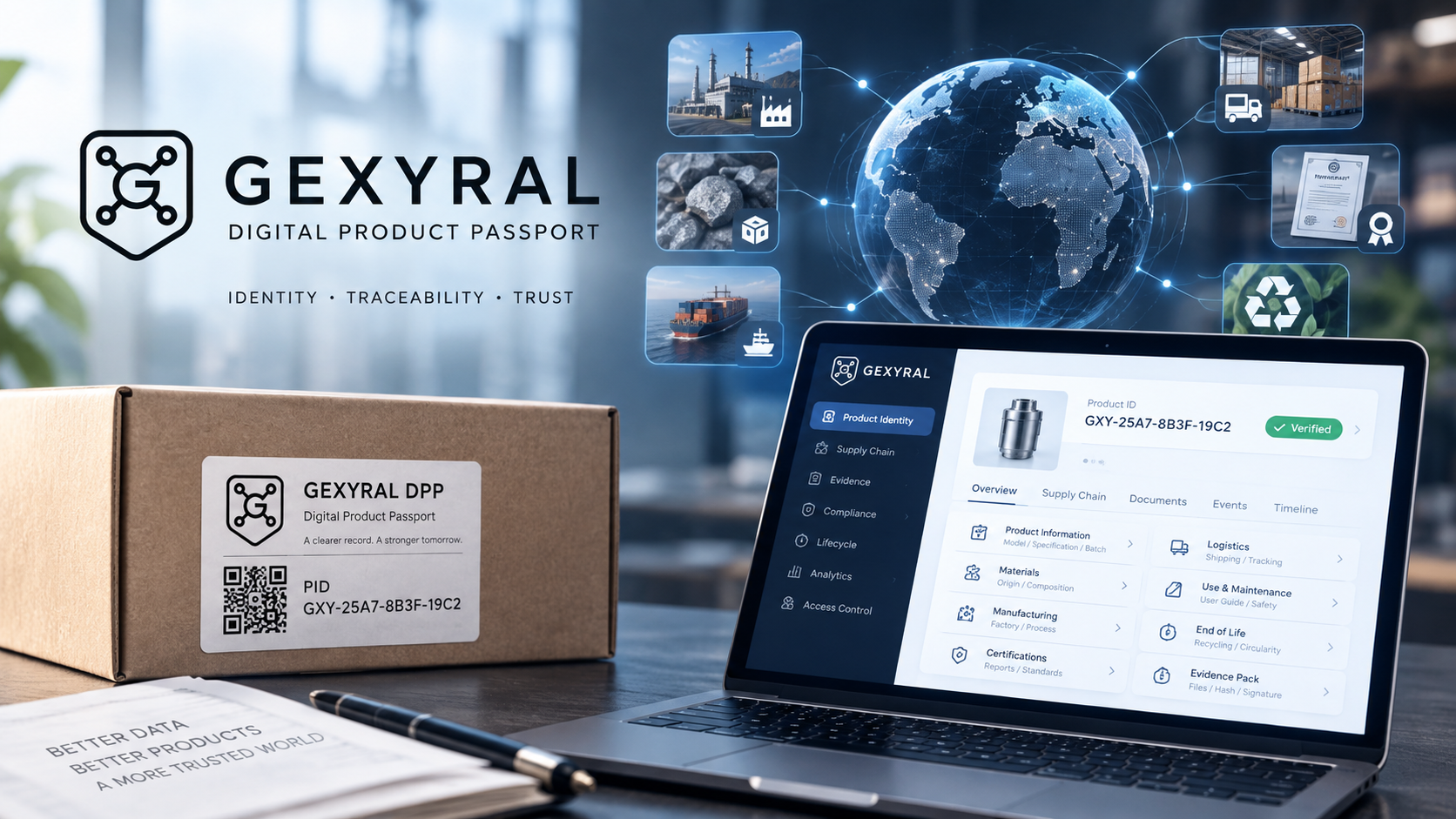
GEXYRAL adopts the idea of PID identity base plus lightweight DPP, which can connect commodity fields, Evidence Pack, Manifest, signature verification and hierarchical access. It is more suitable as a tool for domestic companies to organize product records and prepare DPP data, and cannot replace the company's own quality responsibility, third-party certification or legal compliance judgment.
10. Conclusion: What the industry values is not "leaving one more piece of information", but retaining the basis for judgment
As markets, customers, and systems continue to require companies to explain products, verbal experience and scattered documents become increasingly difficult to support long-term operations. The value of records lies in letting companies know who the product is, what happened, where the basis is, whether the current version is valid, and where to start investigating problems after they arise.
Competition in many industries in the future will not only depend on who can produce goods, but also on who can continue to explain and manage goods. The earlier records are made, the less it will be necessary for companies to make up lessons from scratch when faced with customer reviews, product updates, quality issues and new rules.
Data reference: EU Sustainable Product Eco-Design Framework, Digital Product Passport Related Methodology, and GS1 and UNECE's public information on product identity, machine-readable data and trusted records. Specific obligations for different products should still be subject to applicable regulations and industry requirements.
You can start with a key product, establish a product identity page, organize supporting materials, record scan scanning verification results, and then gradually upgrade to a more complete DPP preparation process as needed.
This article is for knowledge collation and operational suggestions, and does not constitute legal, certification, official compliance or true and false identification conclusions; specific products and transactions should still be judged based on actual evidence, platform rules, testing and certification, and professional opinions.
More industries are treating records as operational infrastructure rather than paperwork. This article explains how...
Suitable for quickly understanding keywords, checking data, sorting out risk points, preparing customer communication or generating product identity records.