
What Happens to Products Without Data in the Future?
Future products must be readable by systems, understandable to partners and verifiable across compliance and service processes. This article examines the market-access, automation, trust, repair, resale and recycling costs of missing product data.
It is used for information collation, scanning code display, evidence filing and risk warning; it does not claim official certification, nor does it replace formal compliance review.
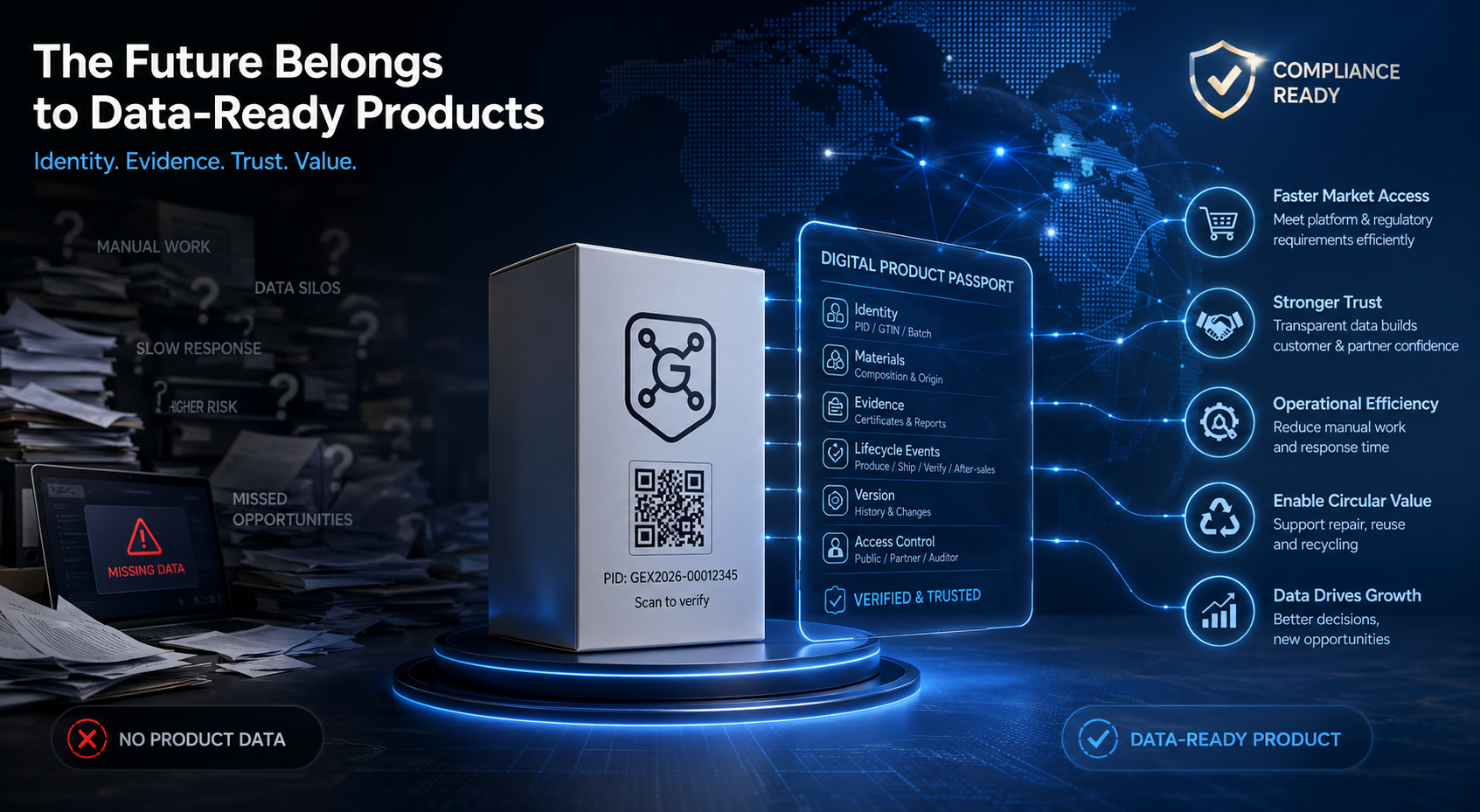
Future products must be readable by systems, understandable to partners and verifiable across compliance and service processes. This article examines the market-access, automation, trust, repair, resale and recycling costs of missing product data.
What will happen to future products if there is no data?
In the past, commodity competition mainly centered on price, quality, channels and brand. These factors will still be important in the future, but an increasingly difficult condition will be added: whether the product has data that can be read by the system, understood by partners, and verified by regulatory authorities.
Goods without data will not disappear from the market immediately. It can still be produced, packaged and sold, but after entering more complex channels, it will continue to encounter manual replenishment of data, missing platform fields, slow customer review, inability to locate after sales and recycling difficulties.
In the long run, product data may change from "better to have" to "it is difficult to participate if there is no bar code and logistics information today."
1. The "commodity data" referred to in the future is not just a parameter table
A product parameter table can only describe part of the static information of the product. Data that can truly support future circulation also needs to connect product identity, evidence sources, version changes, access rights and life cycle events.
| data type | common contents | why it matters |
|---|---|---|
| identity data | PID, GTIN, SKU, model number, batch number | Let different systems know that they are discussing the same product |
| basic data | Materials, specifications, origin, manufacturer, responsible entity | Support display, trading and compliance judgment |
| evidence data | Test report, declaration, certification, instructions and sources | Prove that the key conclusion is not self-explanatory |
| version data | Effective time, modification record, historical version | Confirm that what you currently see is still valid |
| event data | Production, circulation, verification, maintenance, recall, recycling | Support traceability and life cycle management |
| rights data | Who can view, download, modify or verify | Establishing the boundary between transparency and trade secrets |
Therefore, the key to whether a product has data in the future is not how many words are written on the page, but whether the information can be continuously maintained and used credibly around a stable identity.
2. Commodities without data will first lose their "machine intelligibility"
E-commerce platforms, ERP, PIM, logistics systems, customs interfaces, maintenance networks and recycling systems increasingly rely on structured data. Products with only pictures and PDFs still need to be read, judged and re-entered.
Manual processing can still be maintained for a small number of goods. Once the number of SKU increases, the number of sales countries increases, or the partners become complex, the cost will rise rapidly. For goods without machine-readable data, several results often occur:
- Platform fields cannot be automatically mapped and must be filled in repeatedly for each channel.
- Customer questionnaires can only be answered item by item by the sales and quality departments.
- After data is updated, multiple systems cannot be synchronized, which is prone to version conflicts.
- AI and automated tools cannot reliably identify the source of the data and can only generate uncertain answers.
- Partners prefer to choose suppliers with complete data and clear interfaces.
The gap in the future is not just whether there is an official website, but whether a product can enter other people's systems as a standardized data object.
3. Commodities without data will face higher market access costs
The EU's digital product passports, product security, sustainable information disclosure and supply chain due diligence are all pushing companies to transform previously scattered data into sustainably maintained data. The EU DPP Registry, which will be put into operation in July 2026, has further clarified the role of unique identification, registration data and high-level metadata in the DPP system.
This does not mean that all products implement the same set of field requirements immediately. Different products still depend on specific regulations and authorization bills. But the trend is clear enough: when certain types of goods are required to provide digital passports or structured certificates, companies without a data base need to take stock from scratch, while companies that have established identity, fields, and evidence relationships only need to add applicable content.
| enterprise state | Actions when faced with new requirements | possible outcomes |
|---|---|---|
| Only scattered documents | Re-find the data, check the model, and make up the mapping | Long cycle time, easy to miss customers or market time |
| Have unified product master data | Supplementary industry fields and applicable evidence | Adjustment costs are relatively controllable |
| Existing identity, evidence, version and interface | Generate or register required data according to rules | Easier access to new compliance processes |
4. Commodities without data will become increasingly difficult to establish long-term trust
Consumers will not necessarily read complete technical materials, but they will focus on sources, materials, methods of use, maintenance, recycling and brand responsibility. Partners are more concerned about whether the data is consistent, whether the evidence is valid, and whether they can quickly locate problems when they arise.
If the product can only provide one piece of marketing copy, all trust depends on the brand's verbal commitment. Once a dispute between authenticity and authenticity, batch problems or after-sales disputes occurs, it is difficult for companies to produce the current version of the information and objective records.
Data cannot replace quality, but it can allow quality to be explained. For high-priced unit prices, cross-border sales, secondary circulation and long-term after-sales products, this ability will directly affect brand premiums.
5. Without data, repair, resale and recycling will also be restricted
The product life cycle does not end after the first sale. Electronic products need repair and parts matching, furniture and textiles need materials and care information, batteries and equipment need health status and recycling paths, and jewelry and luxury goods may enter the second-hand market.
When a product does not have stable identity and historical data, subsequent services can only rely on model guesses, paper vouchers or consumer descriptions. The maintenance party does not know what parts to use, the recycling party does not know the composition of the materials, the second-hand buyer cannot confirm the source, and the brand also loses the opportunity to continue to connect with the product.
From this perspective, commodity data is not only a compliance cost, but also an infrastructure for after-sales, circular economy and secondary value.
6."Having data" does not mean "data is trustworthy"
What is truly competitive in the future is not the products with the most data, but the products with higher data quality.
| Trusted data characteristics | specific performance | Adverse situation |
|---|---|---|
| Have a stable identity | Data always points to clear goods, batches or individual items | Mix a set of information for the same name product |
| come from somewhere | Key fields can be associated with suppliers, reports, or internal records | Only write conclusions, do not know the basis |
| Time and version | Be able to determine when it takes effect and when it is replaced | Overlay history after page update |
| There are access boundaries | Different roles get the information they need | All sensitive data is disclosed or critical data is completely closed |
| verifiable | Evidence packages, Manifest, signatures, or hashes can assist in checking consistency | Files can be replaced at will and have no trace |
| migratable | Export structured data without being locked by a single page | Data is difficult to take away after changing platforms |
7. Industry platforms are moving from "generating pages" to "managing data"
From Scantrust and Kezzler's product identity and traceability routes, to the supply chain and verifiable data routes of Circularise, TrusTrace, osapiens, and Spherity, to lightweight tools such as MyProductPassport, PassportEU, and DPP-Tool, although the market positioning is different, the common points are obvious: QR codes are just entrances, and long-term value comes from product data, evidence and cross-system connections.
When selecting a tool, companies should not only look at whether they can quickly generate a DPP page, but also whether they support unique identity, batch import, field sources, evidence archiving, version recording, hierarchical access, machine-readable output, and data migration. Otherwise, if the page is built, the bottom layer will still not have sustainable data capabilities.
8. What companies can do now without waiting for the rules to be fully determined
- Select 10 to 50 key SKU and first establish standard commodity files.
- Clarify the identity and granularity of goods: manage them by model, batch or single item.
- Organize materials, origin, manufacturer, responsible subject and key compliance fields.
- Put test reports, statements, instructions and other information into a traceable evidence package.
- Add source, expiration date, and version information to fields and files.
- Prepare machine-readable exports such as JSON-LD, GS1 Digital Link, or API.
- Design access boundaries for consumers, partners, reviewers and insiders.
These tasks will not lose their value due to a certain regulatory adjustment. Even if the final fields change, the identity, evidence, and version base that the company has established can continue to be used.
9. Positioning of GEXYRAL: Let domestic companies have available data bases first
GEXYRAL adopts the route of PID identity base plus lightweight DPP. The focus is not to create the illusion that "it has been fully compliant", but to help domestic brands, factories and cross-border merchants organize product data first. The platform supports product disclosure pages, verification records, Evidence Pack, Manifest, signature verification, hierarchical access, JSON-LD, GS1 compatibility mapping and Registry-ready pre-inspection, and retains integration capabilities for API, Webhooks and connectors.
The difference between it and large overseas enterprise platforms is not that it claims to replace all supply chain systems, but that it is Chinese, directly available locally, and more suitable for small and medium-sized enterprises to start with a small number of products. At this stage, external data preparation and lightweight DPP capabilities should be accurately stated for EU compliance, and should not claim to have obtained official certification or completed legal registration for customers.
10. Conclusion: Products without data will not disappear immediately, but will become more and more expensive
It will rely more on labor, find it more difficult to enter automated channels, respond to compliance requirements, and continue to create value in repair, resale and recycling.
The gap between products in the future will not only be the gap in quality and price, but also the gap in "whether they can be understood, verified, and connected." Goods with complete data are easier to enter new markets and service networks; goods without data require constant re-payment for every interpretation.
For companies, the most realistic choice is not to wait for all rules to be filled in one go after they are implemented, but to start with the product identity, basic fields and evidence records. The sooner product data is formed, the lower the cost of entering DPP, customer review and cross-system collaboration in the future.
Data reference: Official Statement of the European Commission DPP Registry,"Definition Method of Passport Data Requirements for Digital Products under the ESPR Framework" by the European Union Joint Research Center. Specific product obligations are subject to applicable regulations and subsequent rules.
You can start with a key product, establish a product identity page, organize supporting materials, record scan scanning verification results, and then gradually upgrade to a more complete DPP preparation process as needed.
This article is for knowledge collation and operational suggestions, and does not constitute legal, certification, official compliance or true and false identification conclusions; specific products and transactions should still be judged based on actual evidence, platform rules, testing and certification, and professional opinions.
Future products must be readable by systems, understandable to partners and verifiable across compliance and servic...
Suitable for quickly understanding keywords, checking data, sorting out risk points, preparing customer communication or generating product identity records.